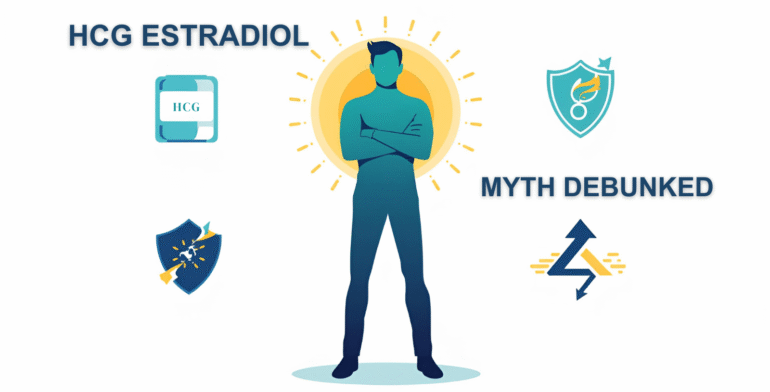
Debunking the Myth: Low-Dose HCG Does Not Significantly Raise Estradiol on TRT
At IncreaseMyT, we specialize in safe, evidence-based hormone optimization to help men reclaim energy, strength, and vitality through personalized Testosterone Replacement Therapy (TRT). A common concern with TRT is its potential to suppress natural testosterone production, leading to issues like reduced fertility or testicular atrophy. Human Chorionic Gonadotropin (HCG), when added at low doses, addresses these by mimicking luteinizing hormone (LH) to stimulate the testes. However, a persistent myth suggests HCG significantly elevates estradiol (E2) levels, risking side effects like gynecomastia or mood instability. Research consistently shows this rise is modest and statistically insignificant at TRT-relevant doses, allowing men to benefit from HCG without added estrogen concerns. Our customized TRT protocols often incorporate low-dose HCG to maintain hormonal balance, fertility, and overall well-being—delivered through convenient subcutaneous injections for optimal absorption and minimal side effects. This approach ensures comprehensive care, monitored by our expert physicians.
HCG’s Pharmacology: A Safe LH Mimic for TRT Enhancement
HCG is a glycoprotein hormone structurally similar to LH, binding to the same receptors in the testes to promote endogenous testosterone and sperm production. In TRT contexts, low doses (typically 250–500 IU, 2–3 times weekly) prevent gonadotropin suppression from exogenous testosterone. Unlike harsher interventions, HCG has a favorable safety profile, with minimal hepatotoxicity and no significant androgenic side effects at these levels. Bioavailability is high via subcutaneous injection, with effects peaking within 24–48 hours. Medically, HCG is used off-label in TRT to sustain intratesticular testosterone (ITT), crucial for fertility and testicular health. Doses are tailored to individual needs, with cycles monitored via bloodwork to track testosterone, estradiol, and hematocrit. Studies confirm its efficacy: a 2022 trial found no notable changes in estradiol, PSA, or hematocrit after weekly HCG dosing. (PMC: Efficacy and Safety of HCG Monotherapy)
Busting the Myth: HCG and Estradiol Levels on TRT
The fear of HCG-induced estradiol spikes stems from its role in boosting testosterone, which can aromatize to E2. However, at low TRT doses, this effect is negligible. A landmark 2013 study in The Journal of Urology analyzed 26 hypogonadal men on TRT with 500 IU HCG every other day for 6.2 months. Testosterone rose dramatically (207.2 ng/dL to 1,055.5 ng/dL, p<0.0001), but E2 only increased modestly (2.2 pg/mL to 3.7 pg/mL, p=0.11—not significant). (ScienceDirect: Low-Dose HCG with TRT) Corroborating evidence abounds. A 2022 study of 31 men on HCG monotherapy (average 1,529 IU weekly) reported E2 rising from 27.5 to 32 pg/mL (p=0.32), with no gynecomastia or other E2-related issues. (PMC: HCG for Hypogonadal Symptoms) Another trial showed low-dose HCG (125–500 IU every other day) maintained ITT without excessive E2 elevation in gonadotropin-suppressed men. (JCEM: HCG Maintains ITT) These findings indicate low-dose HCG integrates safely into TRT, focusing on benefits over mitigation.
HCG Preserves Fertility During TRT
TRT's suppression of LH/FSH can lead to azoospermia, but HCG counters this by stimulating spermatogenesis. The 2013 Urology study found no azoospermia cases, with nine pregnancies during follow-up. (PubMed: Low-Dose HCG Prevents Azoospermia)Further research supports this: A 2024 review showed HCG/FSH restored spermatogenesis in >90% of men post-testosterone use, with motile sperm counts rising from near-zero to 39 million. (Fertility and Sterility: Optimal Spermatogenesis Restoration) In a 2023 analysis, concomitant HCG maintained semen parameters in TRT users. (PMC: Management of Male Fertility on TRT) For men planning families, HCG is indispensable.
HCG’s Emerging Role in Adrenal Support on TRT
Beyond testes, HCG may influence adrenal glands due to LH-like receptors, potentially aiding DHEA and cortisol production—hormones often disrupted by TRT. While research is preliminary, anecdotal and observational data suggest improved hormonal balance. A 2019 review noted HCG's potential to upregulate adrenal androgens, supporting cognitive and energy functions. (Balance My Hormones: Reasons to Use HCG with TRT) Another source highlights DHEA's adrenal origin, with HCG possibly preventing declines. (Men's Health Clinic: Mysteries of HCG) More studies are needed, but many report enhanced vitality, tying into adrenal support.
Enhanced Well-Being and Symptom Relief with HCG on TRT
Men often report superior outcomes with HCG-added TRT. A 2019 study of HCG monotherapy showed 50% symptom relief, with testosterone rising 49.9%. (PMC: HCG Monotherapy for Hypogonadism) In 2022 research, 80% improved libido and 86% erectile function. (Cureus: HCG for Hypogonadal Symptoms) Benefits include better libido, energy, and cognition, possibly from preserved ITT or LH receptor effects. (Men's Health Clinic: Benefits of HCG with TRT) HCG also prevents atrophy, boosting confidence.
Why IncreaseMyT’s TRT with HCG is Superior for Optimal Results
Standard TRT risks fertility loss and atrophy, but our protocols integrate low-dose HCG for comprehensive benefits. Personalized dosing minimizes risks, with regular monitoring ensuring safety.
- Sustains fertility and testicular health
- Enhances well-being without E2 spikes
- Physician-guided for long-term success
Compounded in U.S. pharmacies, our HCG ensures quality and efficacy.
Unlock Optimized TRT with HCG at IncreaseMyT
Low-dose HCG debunks the estradiol myth while preserving fertility, supporting adrenals, and boosting well-being—elevating TRT outcomes. Whether managing hypogonadism or seeking vitality, IncreaseMyT’s HCG-inclusive protocols offer a supervised path forward. Contact us today.
Get Priced
Note: HCG is a prescription medication requiring medical supervision. Individual results vary; potential risks include injection-site reactions or hormone fluctuations. Always consult a healthcare provider before use.