Does Ozempic Cause Thyroid Cancer? The Facts, Rodent Studies, Human Evidence & Safety for Men on TRT
Ozempic (semaglutide) has exploded in popularity for weight loss and metabolic health, especially among men optimizing testosterone through fat reduction. But the FDA black box warning about thyroid cancer has caused real concern. At Increase My T, we help men integrate evidence-based tools like semaglutide into TRT plans to boost energy, strength, and vitality. Here’s the full, up-to-date breakdown based on the latest evidence as of December 2025.
The FDA Black Box Warning: What It Actually Says
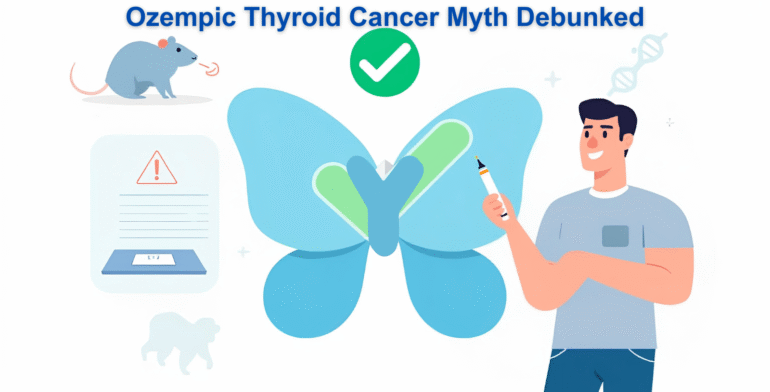
The warning states that semaglutide causes thyroid C-cell tumors in rodents at clinically relevant exposures, but “the human relevance … has not been determined.” It contraindicates use in patients with:
- Personal or family history of MTC
- Multiple Endocrine Neoplasia syndrome type 2 (MEN 2)
Routine thyroid monitoring (e.g., calcitonin levels or ultrasound) is not recommended for other users, as it could lead to unnecessary interventions without proven benefit.
Rodent Studies: Lifetime Exposure & Dose-Dependent Effects in Animals Without Pre-Existing Cancer
The warning originates from long-term carcinogenicity studies in healthy rats and mice (no pre-existing tumors). These involved lifetime exposure — up to 2 years, essentially the animals' entire lifespan — with semaglutide causing a dose-dependent and treatment-duration-dependent increase in thyroid C-cell tumors (adenomas and carcinomas).
Tumors developed starting from normal C-cells, progressing through hyperplasia (overgrowth), elevated calcitonin, benign adenomas, and then malignant carcinomas — but only at higher doses and with prolonged exposure. Lower doses or shorter durations showed minimal or no effect. This response is tied to high GLP-1 receptor expression on rodent thyroid C-cells, which semaglutide strongly activates, promoting uncontrolled growth in this species-specific way.
Primate Studies: Even at High Doses, No C-Cell Changes or Tumors
In contrast, studies in nonhuman primates (e.g., cynomolgus monkeys, biologically much closer to humans) showed no evidence of the same effects. Even when exposed to very high doses — often >60 times human-equivalent levels — for extended periods (up to 87 weeks or longer in some GLP-1 agonist studies, including those relevant to semaglutide mechanisms), primates exhibited:
- No C-cell proliferation or hyperplasia
- No increase in calcitonin levels
- No thyroid tumors or abnormalities
This clear lack of response in primates, despite supra-therapeutic exposures, underscores why the rodent findings are considered species-specific and not predictive for humans.
Why Rodent Results Don’t Translate to Humans: Key Biological Differences
The primary reason is species-specific GLP-1 receptor expression: Rodents have high, functionally active GLP-1 receptors on thyroid C-cells, leading to strong signaling and proliferation. Humans and primates have very low or absent expression on normal thyroid C-cells, resulting in no meaningful activation, no calcitonin rise, and no proliferative changes — even at high exposures.
Latest Human Evidence: No Clear Thyroid Cancer Link (Through 2025)
Large-scale human data consistently shows no significant increased thyroid cancer risk:
- Multisite cohort studies and meta-analyses (2023–2025): No association between semaglutide/GLP-1RAs and thyroid cancer
- Real-world evidence (millions of patients): Incidence remains very low (<1%); any rare signals often due to detection bias from increased monitoring
- Consensus from major reviews and centers: High-grade evidence supports no causal link in general populations
Special Case: Ozempic After Thyroidectomy (No Thyroid Left)
If you’ve had a total thyroidectomy (thyroid fully removed), the theoretical rodent-style risk is irrelevant — no C-cells remain to form tumors.
However, semaglutide can indirectly affect levothyroxine replacement:
- Delayed gastric emptying may alter absorption
- Significant weight loss reduces levothyroxine needs, potentially suppressing TSH
Case reports show some patients needing dose reductions (12.5–25%).
Practical tips:
- Monitor TSH/free T4 4–8 weeks after starting/titrating, then every 3–6 months
- Take levothyroxine on an empty stomach; inject semaglutide separately
- Report symptoms like palpitations or fatigue
Stable thyroid function supports optimal testosterone — so close monitoring is key for men on TRT.
Ozempic Benefits for Men: Weight Loss + Testosterone Optimization
At Increase My T, we view semaglutide as a game-changer for men with obesity-related low T. Excess fat converts testosterone to estrogen; losing it naturally raises free T, energy, and muscle gains. Combined with monitored TRT, it amplifies results without added thyroid cancer concern for most.
Your Next Step
Don’t let outdated fears stop you from evidence-based optimization. At IncreaseMyT, we use doctor-prescribed, lab-monitored protocols — including semaglutide when appropriate — to get and keep you in the optimal range for heart health, vitality, and longevity.
Founder Todd has been helping men optimize hormones with this approach for nearly 20 years.
Get Priced