Tirzepatide: The Recomp King – Optimizing Fat Distribution, Preserving & Building Lean Mass, and Delivering True Recomposition
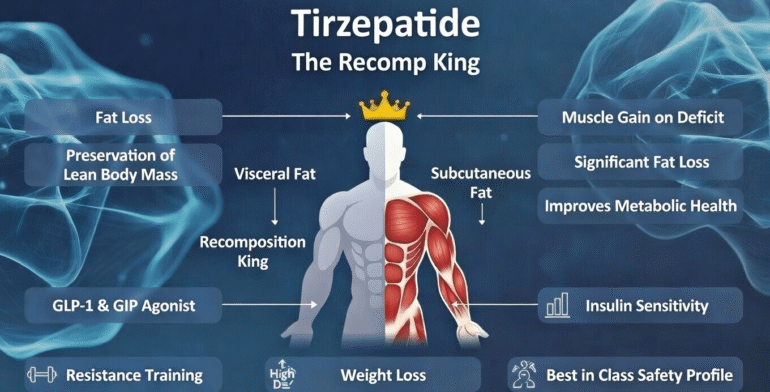
Tirzepatide (Mounjaro / Zepbound), a dual GLP-1/GIP receptor agonist with pronounced GIP activity, has redefined what is possible in the treatment of obesity, type 2 diabetes, and insulin resistance. Beyond impressive total weight loss, tirzepatide excels at improving body composition by preferentially reducing harmful visceral and subcutaneous fat while protecting—and in many cases increasing—lean soft tissue when combined with proper resistance training and adequate protein intake. A landmark 2026 systematic review and network meta-analysis (Qiao et al., Obesity Reviews) established GLP-1 receptor agonists as the clear leaders among weight-loss medications for creating a healthier fat distribution profile. Although tirzepatide was not included in the analysis (literature search closed May 2023), its dual mechanism strongly suggests it would outperform single GLP-1 agonists in head-to-head comparisons. Real-world case reports, large phase 3 trials (SURMOUNT-1, SURPASS-3), and mechanistic evidence further position tirzepatide as the premier agent for true body recomposition—significant fat loss paired with lean mass preservation or gains—for both men and women.
GLP-1 RAs Lead the Field: Key Findings from the 2026 Network Meta-Analysis
Published in Obesity Reviews (doi:10.1111/obr.70100), the Qiao et al. systematic review and network meta-analysis synthesized data from 41 randomized controlled trials involving 2,741 participants treated for approximately 29 weeks. Among all weight-loss drug classes evaluated, GLP-1 receptor agonists (liraglutide, semaglutide, exenatide) ranked highest for producing a favorable fat distribution profile—reducing both deep visceral fat and superficial subcutaneous fat—rather than simply decreasing total body weight. Major results included:
- Visceral adipose tissue (VAT): GLP-1 RAs produced a standardized mean reduction of −0.90 units (95% CI −1.32 to −0.47), outperforming SGLT-2 inhibitors (−0.66 units).
- Subcutaneous adipose tissue (SAT): Only GLP-1 RAs achieved a statistically significant reduction (−1.01 units; 95% CI −1.58 to −0.43).
- Body weight loss: GLP-1 RAs reduced weight by −4.73 kg on average, trailing naltrexone-bupropion (−5.60 kg) in total kilograms but excelling in body composition quality.
- Waist circumference: GLP-1 RAs produced the largest reductions, reflecting their broad “de-fattening” effect across abdominal depots.
These findings underscore that GLP-1–based therapies are uniquely effective at targeting the metabolically dangerous visceral fat compartment while also improving subcutaneous distribution—benefits that tirzepatide appears to amplify through its dual agonism.
Why Tirzepatide Likely Surpasses Single GLP-1 Agonists
Tirzepatide’s dual GLP-1/GIP receptor agonism—with stronger relative GIP activity—drives additive and in some cases weight-independent effects that single GLP-1 agents lack. Key mechanisms include:
- Preferential reduction of visceral fat depots (SURPASS-3 MRI substudy: substantial decreases in VAT and abdominal SAT volume compared with insulin degludec).
- More balanced redistribution of subcutaneous fat, shifting away from metabolically adverse patterns.
- Proportionally favorable lean mass preservation (SURMOUNT-1 DXA substudy: ~74% of weight lost as fat mass, only ~26% as lean mass over 72 weeks).
- GIP-specific, weight-independent actions:
- Enhanced insulin sensitivity in adipose and muscle tissue
- Pituitary stimulation supporting growth hormone and LH/FSH release, which helps maintain sex hormone balance
- Neuroprotective effects (reduced neuroinflammation, preserved synaptic function)
In contrast, emerging triple agonists like retatrutide show improvements in insulin sensitivity and other metabolic parameters that occur roughly in proportion to the degree of weight loss. Tirzepatide’s GIP-driven benefits therefore remain meaningful even when weight reduction is moderate—creating a wider therapeutic window for body recomposition.
Real-World Evidence: Lean Mass Preservation and Gains Are Achievable
A 2025 case series published in SAGE Open Medical Case Reports (Tinsley & Nadolsky) provides compelling proof-of-concept. Three patients (two women, one man; BMI 32.9–51.9 kg/m²) treated with tirzepatide or semaglutide deliberately prioritized lean tissue preservation through structured exercise (4–7 days/week, including resistance training 3–5 days/week) and high protein intake (0.7–1.7 g/kg body mass or 1.6–2.3 g/kg fat-free mass).Body composition outcomes were striking:
- Case 1: −33.0% body weight, −53.4% fat mass, −6.9% lean soft tissue (still far below the 26–40% lean loss typical in trials)
- Case 2: −26.8% body weight, −61.6% fat mass, +2.5% lean soft tissue
- Case 3: −13.2% body weight, −46.9% fat mass, +5.8% lean soft tissue
These results demonstrate that, contrary to common trial averages, lean mass loss is not inevitable—and in motivated individuals following evidence-based lifestyle strategies, tirzepatide can support outright gains in lean tissue during a caloric deficit.
Practical Recomposition for Men and Women
Tirzepatide addresses core drivers of poor body composition—excess visceral fat, insulin resistance, and in many cases secondary hypogonadism—while creating an anabolic-friendly environment when lifestyle is optimized. Practical keys to success:
- Progressive resistance training 3–5 days per week to stimulate muscle protein synthesis
- Protein intake of at least 1.6 g/kg of fat-free mass (ideally 1.8–2.2 g/kg)
- Moderate caloric deficit that allows continued performance in the gym
- Regular monitoring of body composition (DXA or high-quality BIA), hormones, and metabolic markers
This approach yields meaningful improvements in insulin sensitivity, energy, vitality, and long-term cardiometabolic risk—benefits that extend to both men and women pursuing fat loss, metabolic health, or athletic body composition.
Clinical Take-Home Messages
- Tirzepatide is currently the leading pharmacologic tool for optimizing fat distribution and enabling true recomp.
- GIP-mediated effects provide insulin sensitization, hormonal support, and neuroprotection even at modest weight loss levels.
- Resistance training + high protein intake can shift outcomes from lean loss to lean preservation or gains.
- Ideal for men and women with obesity, insulin resistance, metabolic syndrome, or body recomposition goals.
- Always use under physician supervision with regular laboratory and body composition monitoring.
Your Next Step
At IncreaseMyT, we specialize in evidence-based metabolic and hormone optimization for men and women. Our physician-guided programs integrate tirzepatide when clinically appropriate, combined with personalized resistance training guidance, nutrition planning, and ongoing monitoring to maximize fat loss, preserve or build lean mass, and restore metabolic vitality.
Founder Todd brings nearly 20 years of experience applying the latest science to help clients achieve lasting improvements in body composition and overall health.
► Read the 2026 meta-analysis on fat distribution (Wiley)
► Read the 2025 case series on lean mass preservation & gains (SAGE)