
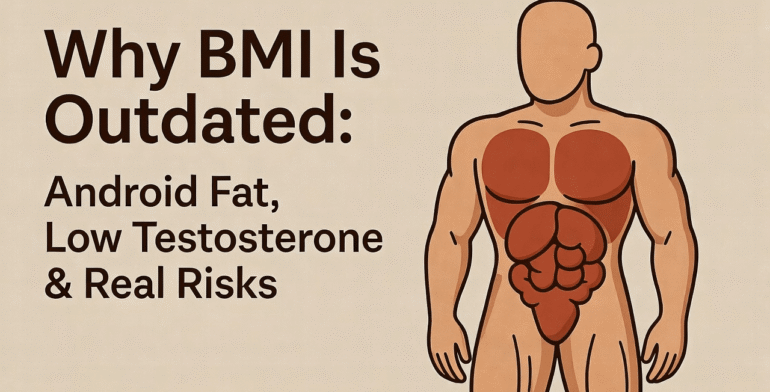
Why BMI Is Outdated and Should Be Eliminated: Android Fat Distribution, Low Testosterone, and Real Disease Risks
Body Mass Index (BMI) has long been the default tool for evaluating weight-related health risks, but it is deeply flawed, outdated, and misleading. Calculated simply as weight in kilograms divided by height squared (kg/m²), BMI fails to distinguish between fat mass, muscle mass, bone density, or—most critically—fat distribution. It frequently misclassifies muscular athletes as overweight or obese while labeling "skinny fat" individuals (normal BMI but high hidden visceral fat) as healthy. Strong evidence shows that android fat distribution—abdominal or visceral fat accumulation—is the primary driver of increased risks for heart disease, type 2 diabetes, and prostate cancer, largely by suppressing testosterone levels and creating a self-perpetuating hormonal and metabolic cycle. It's time to eliminate BMI entirely from routine health assessments in favor of superior indicators like waist-to-hip ratio (WHR), body composition analysis, and testosterone screening.
The Major Flaws of BMI: Why It's Inaccurate and Should Be Eliminated
BMI's simplicity masks its profound limitations. It cannot differentiate fat from lean tissue, leading to misclassification of muscular individuals as obese and "normal weight" people with dangerous visceral fat as healthy. BMI also disregards age, sex, ethnicity, and fat distribution—key factors in disease risk. For instance, central (android) obesity poses far greater threats than peripheral (gynoid) fat, yet BMI captures none of this.
Evidence consistently exposes BMI's weaknesses. Waist-to-hip ratio (WHR) outperforms BMI in predicting mortality and cardiovascular events. In older adults, higher BMI sometimes associates with lower mortality (the "obesity paradox"), often because it reflects protective muscle mass rather than harmful fat. Major health authorities now recommend moving away from BMI reliance due to its biases and inaccuracies across populations. BMI is too unreliable to guide health decisions—it's time to eliminate it altogether as a primary metric.
Android Fat Distribution: The Real Driver of Metabolic and Hormonal Harm
Body fat patterns divide into android (apple-shaped, abdominal/visceral predominance) and gynoid (pear-shaped, hips/thighs). Android distribution, more prevalent in men due to hormonal influences, features high visceral adipose tissue (VAT)—deep fat enveloping organs like the liver, pancreas, and intestines.
Visceral fat is highly metabolically active, releasing inflammatory cytokines, free fatty acids, and adipokines directly into the portal circulation, promoting insulin resistance, dyslipidemia, chronic inflammation, and metabolic syndrome. Unlike protective subcutaneous fat, visceral fat compresses and inflames organs, disrupting function and elevating risks for type 2 diabetes, cardiovascular disease, and certain cancers—independent of total adiposity. Android fat strongly correlates with higher visceral indices and poorer outcomes, making it a superior risk predictor over BMI.
The Vicious Cycle: Visceral Fat Suppresses Testosterone and Escalates Disease
Excess visceral fat directly impairs testosterone production, establishing a bidirectional hypogonadism-obesity cycle. Visceral adipocytes express high aromatase, converting testosterone to estradiol and lowering circulating levels. Low testosterone reduces muscle mass, fat oxidation, and lipolysis in some depots while promoting visceral fat storage.
This low testosterone underlies many diseases linked to high BMI. It drives insulin resistance, dyslipidemia, inflammation, and higher cardiovascular mortality. It worsens diabetes via hyperglycemia and metabolic syndrome. For prostate cancer, low testosterone associates with more aggressive forms in contexts, with visceral fat's inflammatory/hormonal effects heightening risks. Men with elevated visceral adiposity exhibit significantly lower testosterone and greater hypogonadism risk, particularly if older or obese—amplifying disease far beyond BMI's scope.
Normal BMI Can Hide High Risk, While High BMI with Healthy Fat Distribution Predicts Longer Life
Normal BMI provides no assurance of low risk when android fat predominates and testosterone drops. "Skinny fat" individuals—normal weight but high visceral fat—face substantially elevated heart disease, diabetes, and prostate cancer risks from metabolic disruptions and hypogonadism. High WHR can double cardiovascular mortality even at normal BMI.
In contrast, high BMI with low visceral fat—driven by muscle mass (e.g., big quads, athletic physique) and favorable WHR—often predicts superior longevity. Muscle confers metabolic advantages, buffers illness, and counters fat harms. Gynoid fat is protective, lowering inflammation and metabolic risks. The "obesity paradox" in older adults shows higher BMI (from muscle, not visceral fat) linking to reduced mortality. Lower WHR predicts decreased all-cause death, even with elevated BMI. Muscular people with high BMI but normal WHR frequently live longer than average, as lean mass and minimal visceral fat outweigh total weight concerns.
Clinical Take-Home Messages
- BMI is outdated, inaccurate, and should be eliminated—focus on android fat distribution and low testosterone as true risk drivers.
- Android visceral fat lowers testosterone, creating a vicious cycle that heightens heart disease, diabetes, and prostate cancer risks.
- Normal BMI with high android fat equals high risk due to low testosterone; high BMI with muscle and low visceral fat (favorable WHR) predicts longer life.
- Use waist-to-hip ratio, body composition scans (e.g., DXA), and testosterone testing for accurate assessment.
- Prioritize resistance training, protein-rich nutrition, and hormone optimization to target visceral fat and restore testosterone for better metabolic health and longevity.
Your Next Step
At IncreaseMyT, we specialize in evidence-based metabolic and hormone optimization for men and women. Our physician-guided programs target android fat reduction, testosterone restoration, and body composition improvement—moving beyond flawed metrics like BMI to deliver sustainable health gains.
Founder Todd brings nearly 20 years of experience applying the latest science to help clients achieve lasting improvements in fat distribution, hormone balance, and overall vitality.
Intake FormsKey References & Further Reading:
► Waist-to-hip ratio outperforms BMI for mortality prediction (PMC)
► Obesity paradox and muscle mass in older adults (PubMed)
► Visceral fat and low testosterone in men (PMC)
► Android fat distribution and cardiometabolic risk (PubMed)
► Low testosterone and increased cardiovascular mortality (PMC)
► Visceral adiposity and prostate cancer aggressiveness (PubMed)
► Normal weight but high visceral fat (“skinny fat”) risks (PMC)
► Higher muscle mass and better outcomes despite elevated BMI (PubMed)